By Tom Angel
McLean's luxury homes are architecturally diverse — from the preserved mid-century colonials in Elmwood Estates and the grand estate properties in Langley Farms to the contemporary new construction rising throughout McLean Hamlet and Chesterbrook. What unites the interiors that work best across all of these property types is not a single style but a set of principles that translate across architectural contexts. I work with buyers and sellers throughout McLean, and the homes that make the strongest impressions — both at listing and as long-term residences — share these design fundamentals.
Key Takeaways
- The most effective McLean interiors work with the home's architecture rather than against it — style should amplify the bones, not compete with them.
- Warm, natural palettes consistently outperform trend-forward color choices in McLean's luxury market and hold their appeal far longer.
- Scale and proportion are the most commonly mishandled design variables in McLean's larger homes — furniture that's too small reads as poor quality regardless of its actual price.
- Indoor-outdoor connection is an underutilized design opportunity in McLean's estate properties, where lot sizes and mature landscaping create extraordinary settings.
Let the Architecture Lead the Design Direction
McLean's housing stock ranges from architecturally specific historic properties to clean-lined contemporary new builds, and the interiors that feel most resolved are the ones where the design direction responds to what the home already is. A colonial in Langley Farms with original millwork, paneled walls, and formal room proportions responds best to furnishings that honor that formality — not a casual modern aesthetic that contradicts the architecture at every turn. A glass-and-steel contemporary in McLean Hamlet invites restraint and precision, not layered traditional detail.
The most common interior design mistake I see in McLean's luxury listings is imposing a personal aesthetic that fights the home's architecture rather than working with it. Buyers touring a property feel this inconsistency even when they can't articulate it — and it registers as a disconnect that affects how they evaluate the home overall.
The most common interior design mistake I see in McLean's luxury listings is imposing a personal aesthetic that fights the home's architecture rather than working with it. Buyers touring a property feel this inconsistency even when they can't articulate it — and it registers as a disconnect that affects how they evaluate the home overall.
Design Directions by McLean Home Type
- Historic colonial or Tudor — warm woods, classical millwork details, symmetrical furniture arrangements
- Mid-century ranch or rambler — clean lines, warm natural materials, indoor-outdoor flow
- Traditional new construction — current neutrals, transitional furniture, layered lighting
- Contemporary new build — restraint and precision; natural stone, minimal furniture profiles, uninterrupted views
Palette: Warm Neutrals Over Trend-Forward Color
The palette decisions that hold up longest in McLean's luxury homes — and that photograph most effectively in listing contexts — are built around warm neutrals rather than the trend colors that dominate design media at any given moment. Warm whites, soft greige, and muted earthy tones create backgrounds that amplify natural light, complement the warm-toned hardwood floors common throughout McLean's housing stock, and remain appealing across multiple design cycles.
Cool gray — which dominated interiors for years — has faded among McLean buyers who have watched it shift to blue or purple in the northern and western light exposures common throughout the community. Stark white, while popular in editorial contexts, reads as cold and unfinished in the residential settings of McLean's established neighborhoods. Warm-toned neutrals navigate both concerns and consistently generate the broadest positive response from buyers touring properties.
Cool gray — which dominated interiors for years — has faded among McLean buyers who have watched it shift to blue or purple in the northern and western light exposures common throughout the community. Stark white, while popular in editorial contexts, reads as cold and unfinished in the residential settings of McLean's established neighborhoods. Warm-toned neutrals navigate both concerns and consistently generate the broadest positive response from buyers touring properties.
Palette Principles That Hold Up in McLean Interiors
- Walls: warm white or soft greige with clear warm undertones — allows natural light to read clearly
- Trim and millwork: crisp bright white creates the contrast that makes warm walls read as intentional
- Natural materials: warm-toned hardwood, limestone, unlacquered brass, aged bronze
- Accent colors: deep navy, forest green, or warm charcoal — deliberate and sparing
- Avoid: cool gray with blue undertones, stark blue-white, and heavily saturated colors that narrow buyer appeal
Scale and Proportion: The Most Overlooked Variable
McLean's larger homes — the estate properties in Ballantrae, the custom builds in McLean Hamlet, the sprawling colonials throughout the community — create a specific design challenge that many buyers underestimate: furnishing rooms at the right scale. Furniture that would fill a modest room appropriately can read as insufficient and floating in a 20-foot great room or a formal dining room scaled for 12.
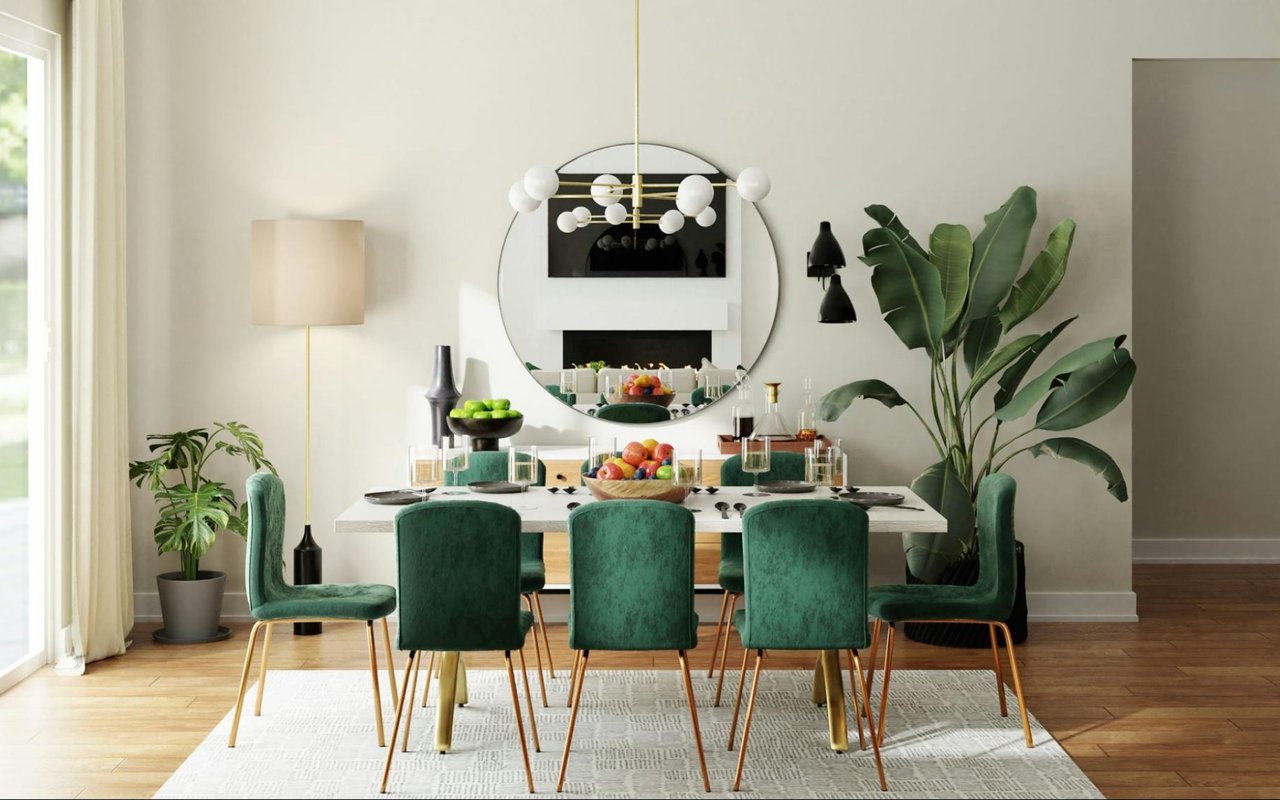
The practical guideline: area rugs should extend under the front legs of all furniture in a seating group, not sit as an island in the center. Dining tables should seat the room's maximum intended capacity without pushing against walls. Sofas should be scaled to the room's depth — in a deeper room, a larger, deeper sofa with a generous sectional configuration reads as intentional, while a standard-depth sofa floats without anchoring the space.
The practical guideline: area rugs should extend under the front legs of all furniture in a seating group, not sit as an island in the center. Dining tables should seat the room's maximum intended capacity without pushing against walls. Sofas should be scaled to the room's depth — in a deeper room, a larger, deeper sofa with a generous sectional configuration reads as intentional, while a standard-depth sofa floats without anchoring the space.
Scale Rules for McLean's Larger Luxury Homes
- Area rugs: large enough to anchor all furniture — a rug that's too small is worse than no rug
- Dining tables: scaled to the room's entertaining capacity; round or oval work in square rooms
- Sofas: deep-seated and scaled to the room's proportion; sectionals appropriate in family rooms
- Window treatments: floor-to-ceiling panels hung close to the ceiling — maximizes perceived height
- Artwork: larger-format pieces on the walls of significant rooms; gallery walls look small in large rooms
The Indoor-Outdoor Opportunity
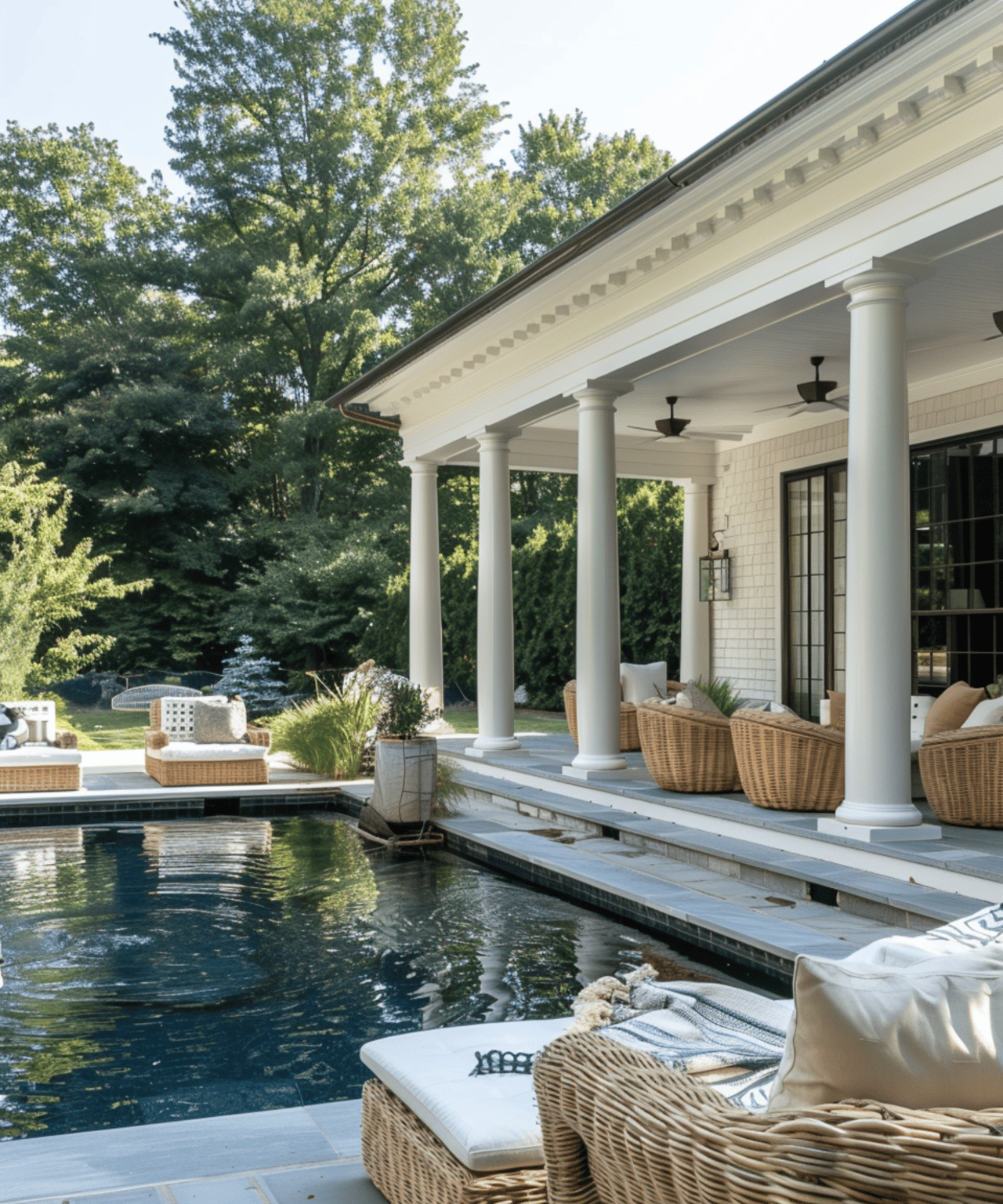
McLean's estate properties — and even the community's more modest lots compared to surrounding Northern Virginia suburbs — offer outdoor living potential that most interiors don't fully capitalize on. The mature trees, established landscaping, and seasonal color of the community's residential neighborhoods create outdoor settings that are genuinely extraordinary when the interior design connects to them intentionally.
Orienting primary seating toward views of the garden, terrace, or mature tree canopy rather than toward interior walls brings the outdoor environment into the visual experience of daily living. Consistent flooring materials at indoor-outdoor transitions — or at minimum complementary tones — create visual continuity that makes interior spaces feel larger and more connected to their setting.
Orienting primary seating toward views of the garden, terrace, or mature tree canopy rather than toward interior walls brings the outdoor environment into the visual experience of daily living. Consistent flooring materials at indoor-outdoor transitions — or at minimum complementary tones — create visual continuity that makes interior spaces feel larger and more connected to their setting.
Frequently Asked Questions
What interior design choices add the most value before listing a McLean home?
Fresh paint in a warm neutral throughout the entire home delivers the highest consistent return — it photographs dramatically better, signals care, and removes buyer mental discounts about dated or worn wall color. Combined with updated light fixtures in current finishes and professional decluttering, these changes consistently produce measurable improvements in how McLean listings perform.
How do we balance historic character with modern function in a McLean renovation?
The approach that works best in McLean's preserved historic properties is updating systems and finishes — kitchen, baths, mechanical — while preserving original architectural detail: plaster walls, millwork, original floors, and distinctive windows. The contrast between current function and historic character is exactly what makes these homes distinctive and what buyers in McLean's most coveted neighborhoods are specifically seeking.
Does interior design quality affect what a McLean home sells for?
Meaningfully. Homes that photograph well, show cohesively, and feel designed rather than assembled consistently generate stronger offers and shorter days on market in McLean's competitive luxury segments. At the price points common throughout McLean's estate market, buyers have high expectations and make decisions in part based on how a home makes them feel — which is fundamentally a design question.
Contact Tom Angel Today
Design decisions in a McLean home — whether you're preparing to sell, settling into a new property, or thinking about a renovation — benefit from local market knowledge and an honest eye for what actually resonates with buyers in this specific community. That's a perspective I bring to every conversation I have with homeowners throughout McLean.
If you're buying or selling in McLean and want guidance rooted in real market experience, let's connect. Reach out to me at Tom Angel Realty and let's talk about your McLean home and your goals.
If you're buying or selling in McLean and want guidance rooted in real market experience, let's connect. Reach out to me at Tom Angel Realty and let's talk about your McLean home and your goals.